workin. Market report: Hamburg office market, Q3 2026
The Hamburg office market remains subdued in the first nine months of 2026. Take-up is noticeably below the previous year's level, vacancy continues to rise, and prime rent has stabilised at a high level.
Key message
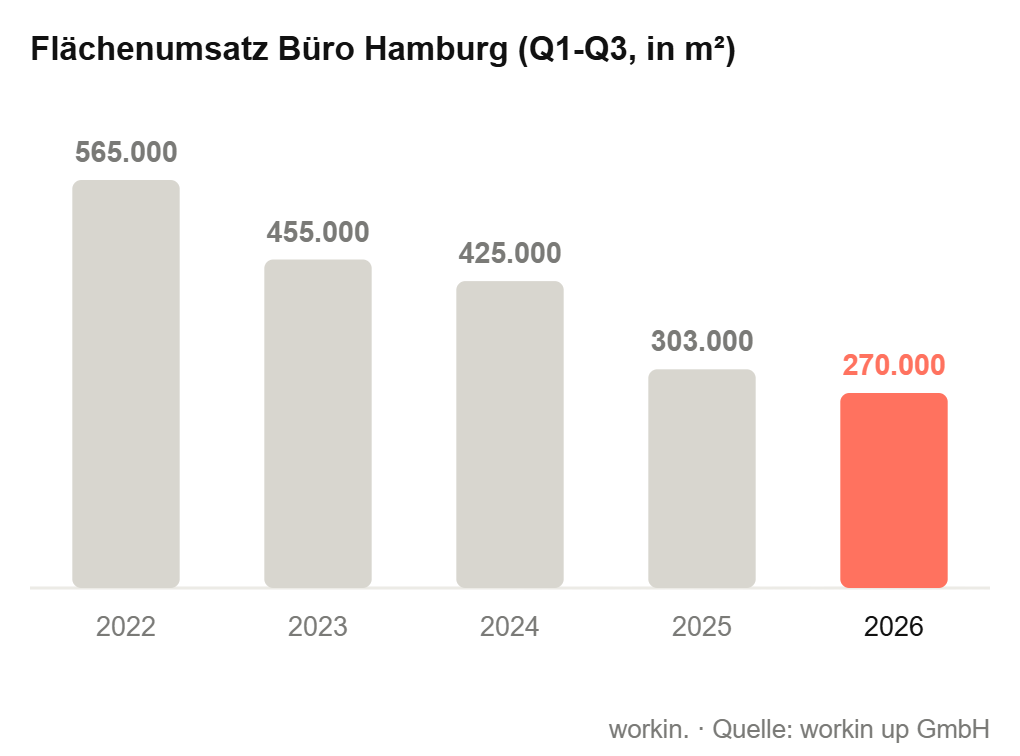
The Hamburg office market remains subdued in the first nine months of 2026. Take-up is noticeably below the previous year's level, vacancy continues to rise, and prime rents have stabilised at a high level. Companies are making decisions more cautiously, spending longer reviewing their space strategies and more often extending existing leases rather than relocating. Quality beats floor space: demand is concentrated on smaller, high-quality space in good locations.
01 Take-up
- From January to September 2026, take-up of office space amounted to around 270.000 m².
- That corresponds to a decline of around 9 % on the same period last year.
- Compared with the long-term average, take-up is significantly lower: the gap to the 10-year average is around a quarter.
- The market is being driven almost entirely by small-scale deals: the bulk of take-up is accounted for by contracts of up to 3.000 m², while large-volume lettings above 10.000 m² were absent in the third quarter.
- For 2026 as a whole, we expect take-up to be at or slightly below the previous year's level, probably between 360.000 and 400.000 m².
02 Vacancy
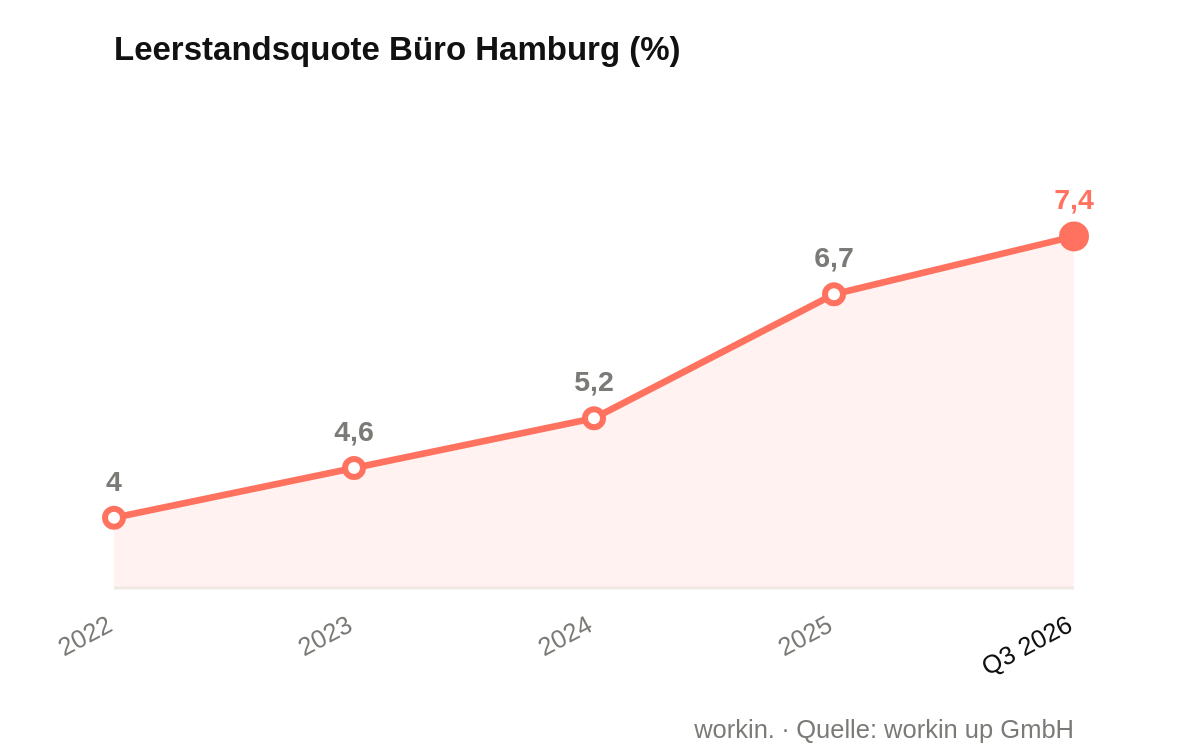
- The vacancy rate rose to 7.4% at the end of the third quarter, up from 7.2% at mid-year.
- The vacancy rate has risen by more than one percentage point year on year.
- Around 1,06 million m² of office space are available at short notice.
- Notably, the share of modern, up-to-date fitted space within the overall vacancy remains low. Many vacant properties no longer meet today's occupier requirements.
- The pipeline remains well filled: around 190.000–440.000 m² are under construction or in planning for 2026/2027, with a pre-letting rate of roughly two thirds of the space available at short notice.
03 Rent
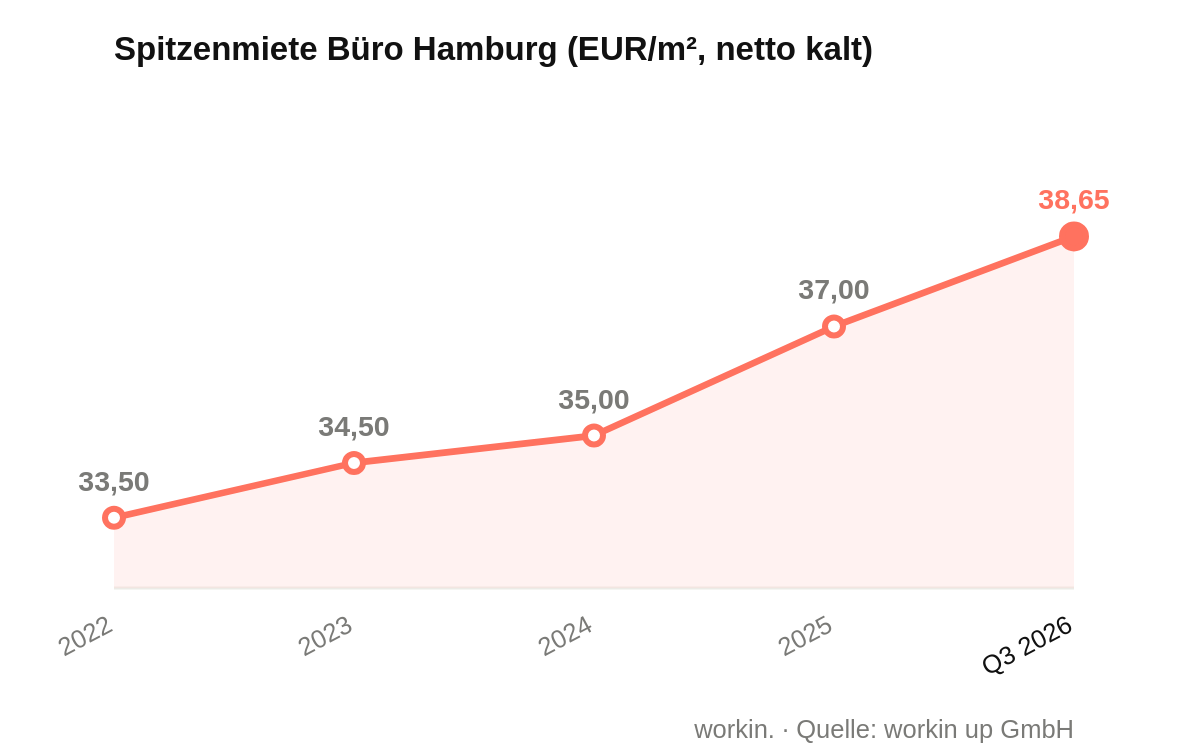
- The prime rent averages 38.65 EUR/m² per month across current market reports, net cold (range 37.00–41.00 EUR/m²), an increase of around 4–14 % on the previous year, depending on the survey. Compared with the previous quarter, the figure is stable.
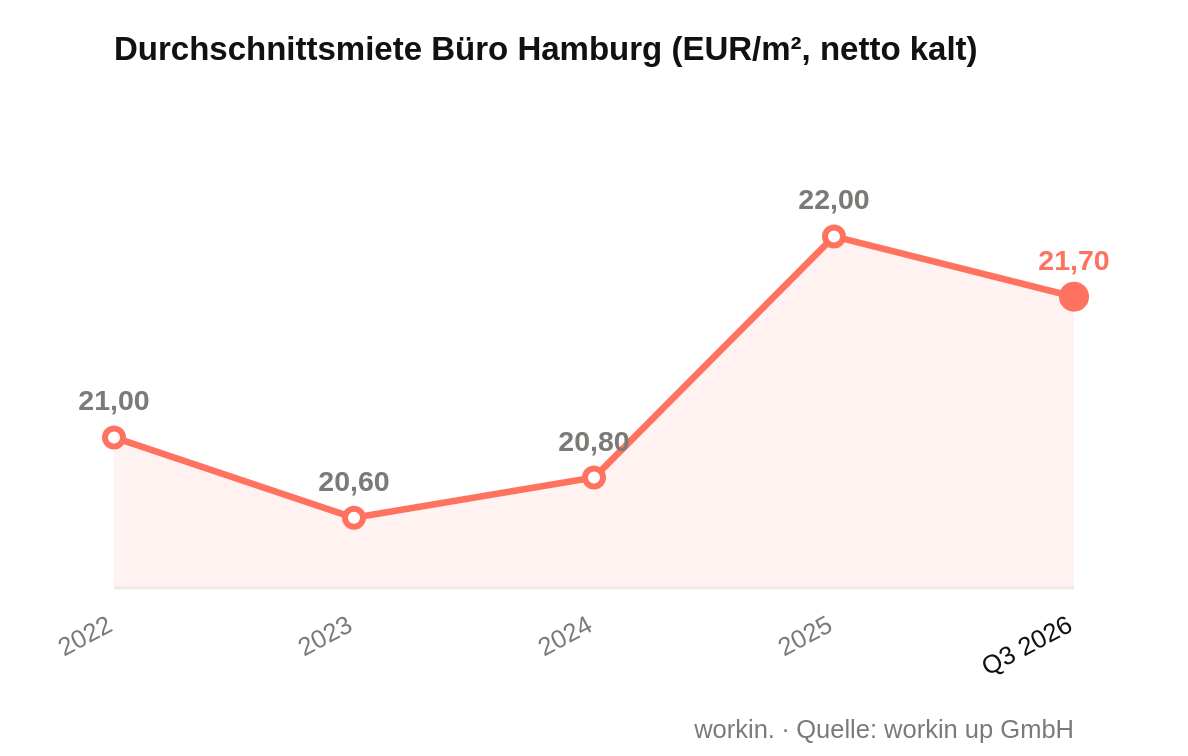
- The average rent stands at 21.70 EUR/m², slightly below the previous quarter's figure but almost stable year on year.
- The gap between prime and average rents remains considerable: for top properties in the best locations, occupiers are still willing to pay higher rents, while the wider market remains more moderate.
- Around 40 euros per square metre marks a psychological pain threshold for most occupiers of new-build space.
04 What this means for tenants
- There is most room for negotiation in existing stock, particularly with older, less modern space away from the prime locations.
- High-quality, contiguous space in the city centre remains scarce. If you are looking for a central location and high quality, you should expect limited availability and correspondingly high rents.
- Many companies are currently opting for lease extensions rather than relocation. This buys time, but it also delays structural adjustments to their space strategy.
- Tenants should plan early: decision-making processes take longer, and space on offer in good-quality buildings is increasingly allocated on a selective basis.
- The question of compromise remains central: budget, quality or location. Getting all three at once is becoming more difficult.
05 Outlook
- For the full year 2026 we expect take-up to fall slightly short of the previous year's level, with potential for a modest pick-up in the final quarter driven by several concrete large-scale requirements in the market.
- The prime rent is likely to remain stable or rise slightly by the end of the year, supported by continued strong demand for premium space alongside limited supply.
- Vacancy will continue to rise slightly in the short term, as the completion pipeline exceeds the current level of lettings.
- Structurally, the polarisation of the market persists: modern, certified space in good locations remains in demand, while older existing stock is coming under increasing pressure, with a growing need for repositioning or alternative use concepts.
Sources
- Quelle: workin up GmbH

workin. Hamburg: people in front, AI behind
workin. is Hamburg's AI-native real estate advisor for office space. Three advisors take care of you. Our own system takes care of the rest.
Hamburg prime office rent Q2 2026: 41 euros, and what's behind it
Why the top end is rising while the wider market weakens, and what that means for normal budgets.
HafenCity vs. Speicherstadt: which base suits whom?
World Heritage brick or new-build glass, rents, transport links and the reality behind both addresses.